
Move the work behind each platform
A UK mortgage lender's data and reporting work was split across Redshift, Kleene.ai and Tableau Server.
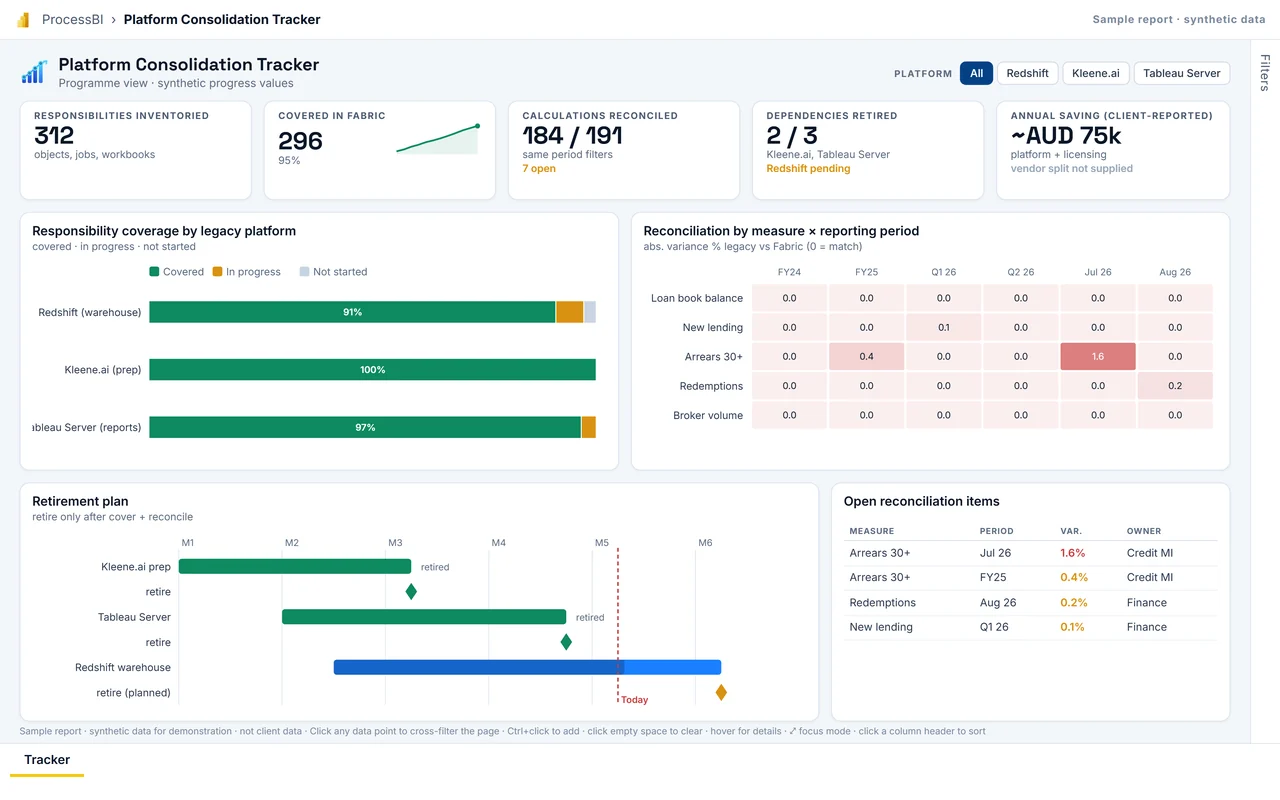
The move to Fabric had to cover those responsibilities while preserving critical reporting. Removing a licence was only useful once its work was covered.
 Microsoft Fabric
Bring the data responsibilities together
The starting estate served three purposes: Redshift held the warehouse, Kleene.ai prepared data and Tableau Server delivered reporting.
Fabric became the connected target for data and reporting, bringing ingestion, preparation and modelling into the new estate. The scope extended beyond replacing individual products.
Reconcile before retiring dependencies
Reconciliation focused on calculations and reporting periods. Reporting meaning had to survive the move, not change silently with the platform.
Replaced dependencies could be retired once their work was covered. That condition connected the migration to a simpler estate, while keeping critical reporting in view.
Our methodology
- 01DiscoverAgree the outcome, the decisions and the requirements.
- 02Current stateMap how the work and data flow today, with evidence.
- 03Root causesFind what drives the delay, rework or disagreeing numbers.
- 04ApproachAgree the target design, scope and measures of success.
- 05BuildBuild the process change, model or report the design calls for.
- 06OptimiseTest at real volumes; tune speed, cost and usability.
- 07ProductioniseRelease with managed deployment, monitoring and support.
- 08GovernSet owners, access and controls so it keeps working.

Steps in this diagram
Lanes: Migration team, Reporting owner, Steering group, Vendor / licensing.
- Dependency in scope
- Inventory its responsibilities
- Cover each in Fabric
- Reconcile calcs + periods
- Matches?
- Fix definition / data
- Approve retirement
- Retire + end licence
- Simpler estate

Components in this design
- Amazon Redshift (warehouse)
- Kleene.ai (data preparation)
- Tableau Server (reporting)
- Data pipelines (source ingestion)
- Copy job (history from Redshift)
- Dataflow Gen2 (replaces prep jobs)
- Notebooks (complex transforms)
- Fabric warehouse (Gold)
- Reconciliation (calcs + periods)
- Semantic model (same definitions)
- Power BI reports (replace workbooks)
Reference design: how this pattern is typically built on Microsoft services. Component choices for a specific engagement depend on the client's environment and existing licences.
Microsoft icons are used under Microsoft's terms. Icon notices
Synthetic sample data, not client data.
Annual platform saving
Reported saving
Saving amount · AUD · axis starts at zero
Approximate client-reported annual platform and licensing saving.
Paying for several platforms that do one job?
Tell us what is happening. We agree priorities and scope before proposing any work.