
Stop rebuilding the case from separate records
Requests, loan details and follow-up actions sat across inboxes and separate records. Staff had to reconstruct that context before moving the work forward.
The hub brings the customer request, selected loans and history into one workspace. Owners, workflow status and outstanding actions stay connected to the case.
Keep approval, acceptance and action distinct
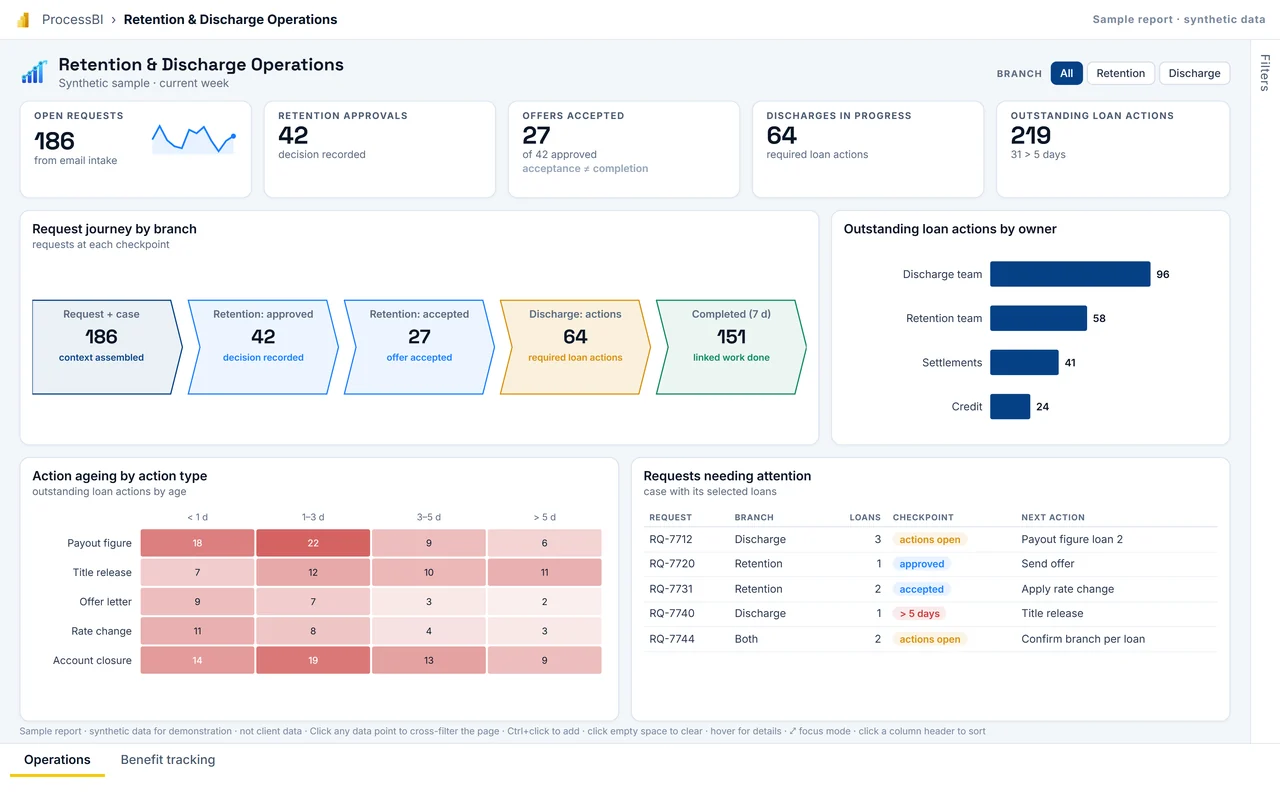
For retention work, approval and an accepted offer are recorded before the relevant actions progress. Neither should be confused with completing the linked work.
Discharge follows its required loan actions. Retention and discharge are applicable branches: a request does not have to travel through both to reach completion.
An open action needs its context
Each request is linked to the selected loans, owners and outstanding actions. That keeps the next action attached to the work it concerns.
Unfinished loan actions remain visible until their linked work is complete. The shared case gives the overall context without replacing the loan-level completion checks.
Our methodology
- 01DiscoverAgree the outcome, the decisions and the requirements.
- 02Current stateMap how the work and data flow today, with evidence.
- 03Root causesFind what drives the delay, rework or disagreeing numbers.
- 04ApproachAgree the target design, scope and measures of success.
- 05BuildBuild the process change, model or report the design calls for.
- 06OptimiseTest at real volumes; tune speed, cost and usability.
- 07ProductioniseRelease with managed deployment, monitoring and support.
- 08GovernSet owners, access and controls so it keeps working.

Steps in this diagram
Lanes: Customer, Shared inbox, Retention / discharge staff, Loan system.
- Email request
- Sits in inbox
- Rebuild context from records
- Look up each loan
- Do actions, track in notes
- Customer chases
- Completion unclear

Steps in this diagram
Lanes: Customer, Hub (automated), Retention team, Discharge team.
- Email request
- Create case + link selected loans
- Branch per loan
- Approval recorded
- Accept offer
- Retention actions
- Required discharge actions
- All loan actions complete?
- Mark case complete
- Customer notified

Components in this design
- Customer email (shared mailbox)
- Loan system (loan context)
- Logic Apps (workflow automation)
- FastAPI (integration API)
- App Service (hub application)
- Azure Foundry (scenario decision support)
- Azure SQL Database (cases, loans, actions)
- Fabric pipelines (data pipelines)
- Operations report (sample report on this page)
- Azure DevOps (code management)
Reference design: how this pattern is typically built on Microsoft services. Component choices for a specific engagement depend on the client's environment and existing licences.
Microsoft icons are used under Microsoft's terms. Icon notices
Synthetic sample data, not client data.
Estimated improvement, shown against a baseline
Email-request processing time
Processing-time index · before = 100 · lower is better
The striped segment marks the estimated range. Final index 60–70 means 30–40% less handling time; an hourly baseline has not been supplied.
Processing accuracy
Accuracy index · baseline = 100 · higher is better
Index 150 represents a 50% relative improvement. The absolute accuracy rate and its baseline have not been supplied.
These are projected benefits, not measured production results.
Are requests rebuilt from inboxes before anyone can act?
Tell us what is happening. We agree priorities and scope before proposing any work.