Reporting foundation
Database design and a clear data-preparation path.
Reporting and workflow delivery supporting major Australian superannuation funds, with reconciled data, repeatable reporting and Power Automate integration.

At a superannuation administration provider, reporting relied on recurring preparation, system interactions and database changes. Manual work behind the dashboard made that path harder to manage.
The engagement brought Power BI delivery together with process automation, data pipelines, database design and migration testing. It addressed the work producing the report as well as the report itself.
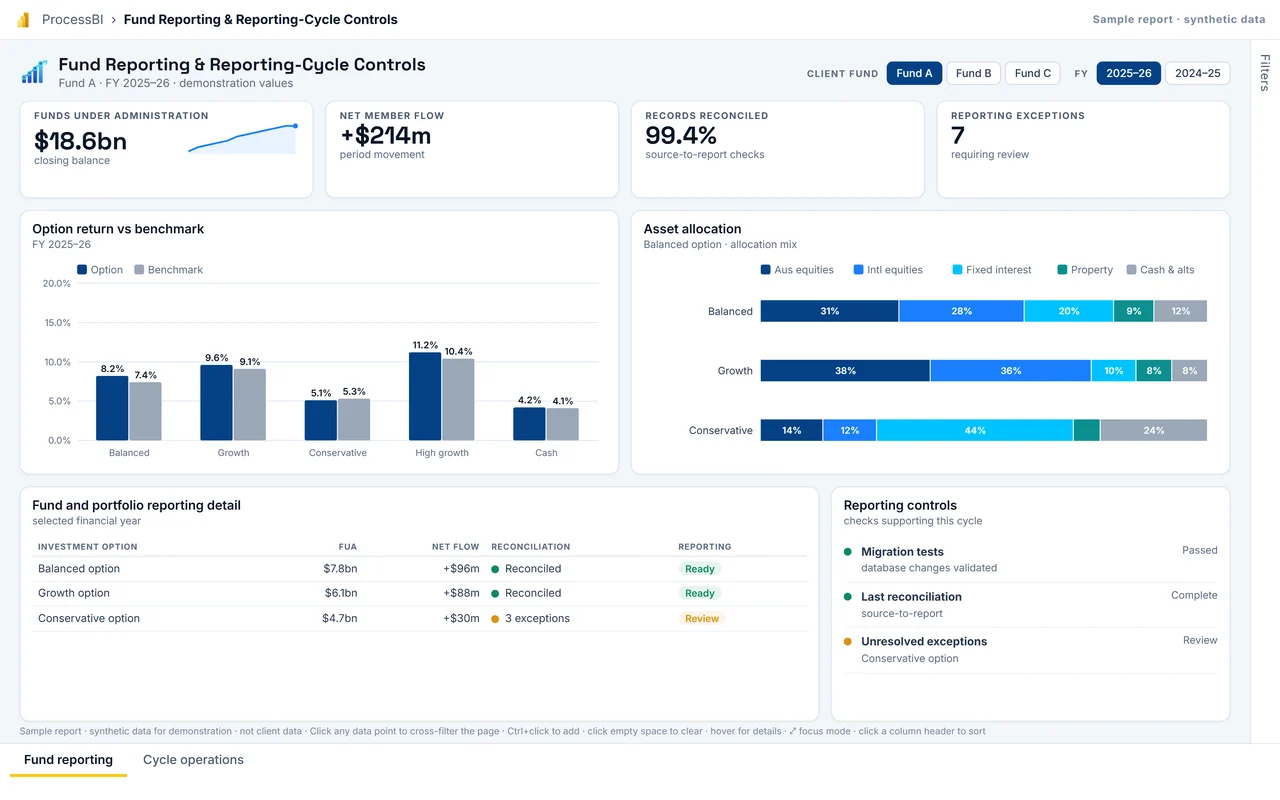
The interactive Power BI sample report further down this page shows how client and portfolio reporting is organised, with the controls behind each result.
Recurring administration interactions were handled through Power Automate RPA. This was a distinct part of the delivery, alongside the data-pipeline work in SSIS and Azure Data Factory.
SQL database design and migration supported the reporting foundation. Keeping these roles clear explains why a reporting engagement also involved automation and database work.
Database changes were accompanied by migration testing and report tests. Power BI reporting was delivered alongside that validation, rather than described in isolation from its data foundation.
The delivery combined repeatable reporting, automated administration interactions and tested database migration within the administration provider.

Lanes: Automation (RPA + pipelines), Reporting analyst, Platform team, Client fund.

Reference design: how this pattern is typically built on Microsoft services. Component choices for a specific engagement depend on the client's environment and existing licences.
Microsoft icons are used under Microsoft's terms. Icon notices
Synthetic sample data, not client data.
Database design and a clear data-preparation path.
RPA for recurring administration interactions.
SQL migration and validation alongside Power BI delivery.
Outcome reported as delivered scope.
Tell us what is happening. We agree priorities and scope before proposing any work.