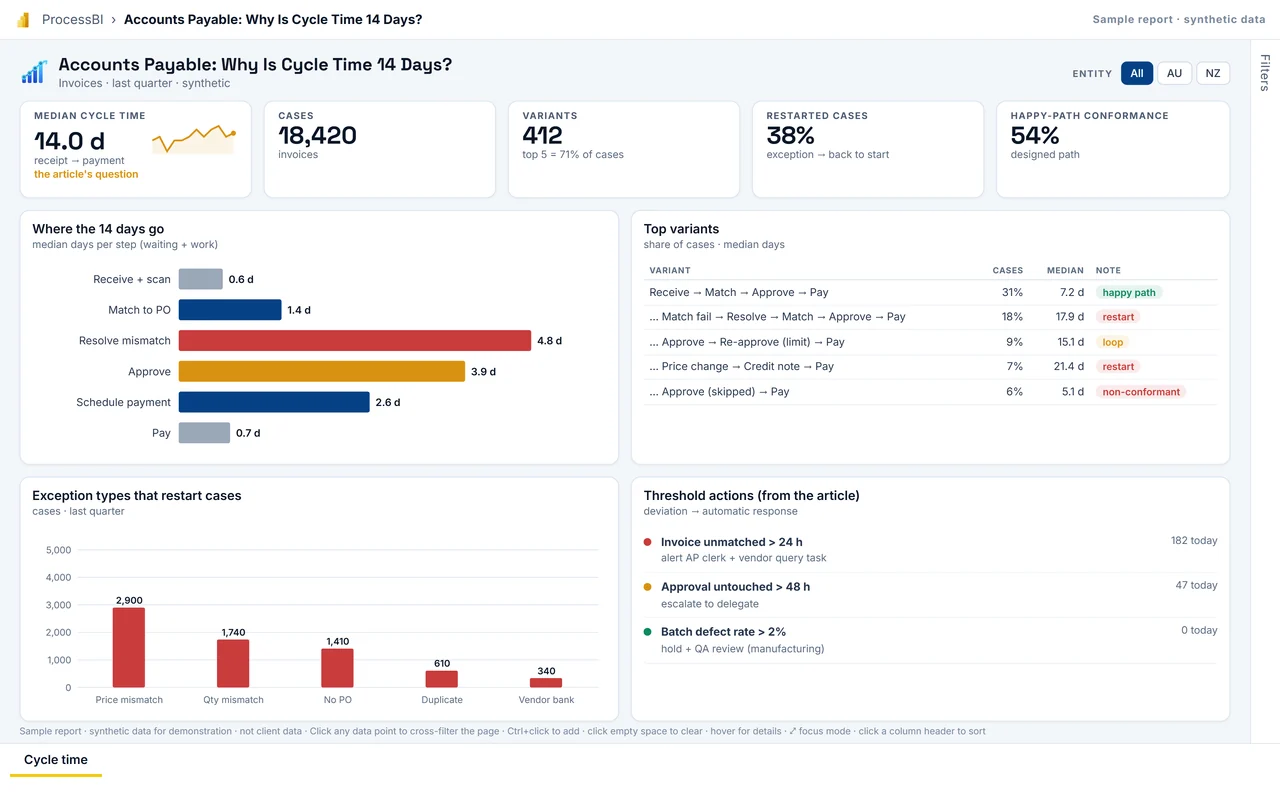
Here is a question worth asking in your next leadership meeting: why is our accounts payable cycle time 14 days?
Not "what is it" — you have dashboards for that. Why is it 14 days? Which steps are consuming which proportion of that time? Which handoffs are introducing delay? Which exception types are causing 40% of cases to restart from the beginning?
Most executive teams cannot answer these questions with specificity. They know the headline metric. They do not know the operational reality behind it. This gap — between measuring outcomes and understanding processes — is the defining failure mode of the modern enterprise analytics investment. Many Australian organisations have invested heavily in business intelligence. Most of them measure more than they ever have. Few of them understand their operations better than they did before.
The problem is not the dashboards. The problem is what the dashboards are built on.
Process intelligence is the discipline of closing this gap. It combines real-time process visibility, operational analytics, and automation triggers into a unified operational layer — one that tells you not just what your business is producing, but how it is producing it, where it is failing, and what to do about it.
What Is Process Intelligence — and What It Is Not
Process intelligence is frequently conflated with two adjacent concepts that are, at best, components of it.
The first is process mining. Process mining is an analytical technique that extracts event logs from operational systems — your ERP, CRM, workflow engine — and uses them to reconstruct how work actually flows, as opposed to how you think it flows. It surfaces deviations, bottlenecks, and ghost steps that never appear in any documented process map. It is a powerful diagnostic tool. But it gives you a picture of what has happened. It does not, by itself, give you the intelligence layer to act on it.
The second is business intelligence. BI platforms provide the measurement and visualisation capability to track operational performance at scale. But BI built on top of inconsistent, undocumented processes produces inconsistent, unreliable output. The old principle holds: garbage in, garbage out — just with better charts.
Process intelligence sits above both. It combines three integrated capabilities:
You can see every handoff, wait state, and exception in a process as it happens — not in a monthly report, not in a weekly review, but in near-real-time as the work moves through your systems.
The data generated by your processes is connected to your analytics layer correctly — which requires that your processes are documented, standardised, and instrumented. When they are, analytics stops describing outcomes and starts explaining causes.
When a process deviation crosses a defined threshold — an invoice unmatched for more than 24 hours, a contract approval untouched for 48 hours, a production batch above a 2% defect rate — the system triggers a response automatically. An alert, an escalation, a remediation workflow.
These three capabilities together constitute process intelligence. None is sufficient alone. Together, they create the closed loop between operations and insight that most enterprise BI investments promise and fail to deliver.
Why Process-First Matters Before Analytics
There is a pattern that plays out in Australian enterprises with uncomfortable regularity.
An organisation invests in a BI platform. Dashboards are built. Power BI is deployed across the business. Training sessions are held, governance frameworks are established, a BI team is hired. The project is delivered on time and on scope. The dashboards are genuinely impressive.
Six months later, the operations team is still making decisions the same way they always have. The data does not match what they know to be true from the floor. Different teams classify the same thing differently. Timestamps are unreliable because system dates are entered manually. Key process steps are missing from the data entirely because they happen via email and never get logged.
The BI layer was built on top of processes that were never documented, never standardised, and never instrumented correctly. The data coming out of those processes is inherently inconsistent. No dashboard can fix that. No data governance framework can compensate for a process that generates unreliable data by design.
This is the core argument for process-first analytics. Before any analytics layer is designed, before any data model is built, the process must be understood, documented, and optimised. Not as a preamble to the "real work" — but as the single most important determinant of whether the analytics investment returns anything at all.
If your organisation has completed a BI implementation and is not seeing the operational change you expected, this is almost certainly where to look. The gap is upstream of the dashboards. Our services are designed precisely to find it.
The Three Layers of Process Intelligence
Process intelligence is built in three connected layers. Each must be in place before the next is worth building.
Layer 1 — Map: Reconstruct Reality
The first layer is diagnostic. You reconstruct the actual current-state process — not as documented, not as described in policy, but as it is actually executed today, including all its variations, exceptions, and informal workarounds.
This involves a combination of process mining (where event logs are available), structured discovery workshops with the people who do the work, and stakeholder interviews that probe for the unofficial steps that never make it into any documentation. The output is a current-state process map that shows every decision point, every handoff, every wait state, and every rework loop.
For most organisations, what this reveals is confronting. The as-is process rarely matches any documented version. There are manual steps that should have been eliminated years ago. There are approval gates administered differently by different people. There are handoffs between teams where no one owns what happens in between.
The Map layer does not redesign anything. It describes what exists. That description is the foundation on which every other layer depends. Attempting to build an analytics layer without it is a common reason BI investments underdeliver.
Layer 2 — Measure: Instrument the Process
Once the process is mapped, you instrument it. You identify the key performance indicators that actually reflect process health — not just output metrics, but leading indicators: cycle time at each stage, handoff delay, exception rate, rework frequency, automation coverage, first-pass yield.
This is where the analytics layer is designed — correctly, on a foundation of clean, well-defined process data. Microsoft Fabric and Power BI are particularly effective at this layer: operational event data from across your systems lands in OneLake, is processed through Fabric's data pipelines, and surfaces in Power BI as real-time process dashboards with alerting built in.
The Measure layer also establishes your baseline. Every improvement claim requires a before-state measurement. Without it, you cannot demonstrate that an intervention worked, and you cannot identify where to invest next. This is a discipline that most BI implementations skip — and the omission makes it impossible to close the loop.
Layer 3 — Automate: Make the Optimised Process Scale
Automation is applied last — not first. Once a process is mapped, measured, and optimised, the repetitive, rules-based steps become candidates for automation using Power Automate, Copilot Studio, AI agents, or RPA tooling.
The principle is straightforward: automate what is worth automating, in a process that has already been made worth automating. Automating a broken process accelerates failure. Automating an optimised process delivers compounding return — and generates the clean event data that feeds back into the Measure layer to confirm the improvement is sustained.
The Automate layer also includes intelligent alerting: configuring the analytics layer to notify the right person when a process deviation occurs, before the deviation becomes a breach or an incident.
Real-World Outcome Shapes
Fabricated benchmarks help no one. Every engagement is different, every process is different, and quoting a specific dollar saving from a hypothetical situation misleads more than it informs. What can be described is the consistent shape of outcomes across process intelligence engagements.
Approval Cycle Time Reduction
Separate working time from waiting time using event timestamps and observations. Investigate approval queues, missing information and repeated handovers. Measure cycle time before and after changes against the same process boundaries.
SLA Compliance Improvement
Track records approaching their deadlines and route exceptions to an accountable owner. Measure on-time completion, overdue work and false alerts against the baseline; monitoring alone does not guarantee an improvement.
Manual Touchpoint Elimination
Review manual steps for duplication, unnecessary approvals and avoidable re-entry. Prioritise changes by effort, risk and frequency, then measure the hours saved rather than assuming a standard reduction.
Important: These outcomes are shapes, not guarantees. The starting point, process complexity, system landscape, and organisational readiness all affect what is achievable. A good process intelligence partner will baseline your processes before making any claims about improvement targets — and should refuse to engage with vague ROI promises that are not grounded in your actual data.
How Microsoft Fabric Enables Process Intelligence at Scale
For Australian enterprises operating at mid-market to enterprise scale, Microsoft Fabric is a credible platform for building a process intelligence layer. The reason is architectural.
Fabric's OneLake provides a unified data store for operational data from across your business systems — ERP, CRM, HRIS, custom applications, workflow engines. Fabric's data pipelines (Dataflow Gen2, Data Factory) can ingest event-level process data from those systems in near-real-time. Fabric Lakehouses and Warehouses handle transformation and storage at scale. Power BI provides the visualisation and alerting layer, integrated directly into the Fabric workspace without additional connectors or data movement.
What this means in practice: process data — the timestamps, handoffs, decision records, and exception logs that constitute the evidence of how your processes actually run — can be centralised, processed, and surfaced to the people who need it, at the cadence they need it, without a complex custom data engineering stack.
For organisations already in the Microsoft 365 and Azure ecosystem, the integration is usually simpler than assembling separate services. Event data from SharePoint workflows, Teams approvals, Dynamics 365, and Power Automate flows can land in OneLake through native connectors. Process dashboards in Power BI can surface deviations and alert on them in near-real-time. Copilot integration means analysts can query process data in natural language without writing DAX.
This is not a future capability. For Australian organisations that have completed a Fabric foundation engagement, this stack is deployable today. The question is whether the processes feeding it are clean enough to make the investment worthwhile — which is why a process-first approach remains the prerequisite.
What to Look for in a Process Intelligence Consulting Partner
Process intelligence partners in Australia tend to come from one of two directions. Most firms approach it from one of two directions: either they are BI implementation houses that have added process mining as an upsell, or they are process consultants who lack the data platform capability to operationalise what they map.
The distinction that matters is whether a firm is methodology-led or tool-led.
A tool-led firm will recommend a process mining platform on day one. They will run the event log analysis, produce a visualisation of your current process, and hand you documentation. You will have a spaghetti diagram. You will have something for a presentation. You will still have no structured plan for what to do about it, and no analytics layer to measure whether anything changes.
A methodology-led firm starts differently. Process discovery — structured workshops with the people who do the work — comes before any software is opened. Process mining is used as an analytical input to validate and extend what discovery surfaces, not as a substitute for it. The measurement framework is designed before the BI layer, so dashboards are built on metrics that reflect process reality. Automation recommendations are grounded in process logic, not vendor capability lists.
When evaluating a process intelligence consulting partner for your Australian enterprise, look for the following:
Methodology transparency
Ask to see the engagement framework — the sequence of activities, the deliverable structure, the decision criteria for moving between phases. If the answer is vague, the methodology does not exist.
Process credentials
Lean Six Sigma training, BPMN 2.0 competency, and ISO 9001 experience indicate a structured approach to process work. They are not sufficient on their own, but their absence is a red flag.
Microsoft Fabric capability — not just Power BI
Power BI competency is table stakes. What matters for process intelligence is the ability to design the data architecture beneath the dashboards — OneLake structure, pipeline design, semantic model governance, and data quality controls.
Industry specificity
Ask for documented examples of cycle time reduction or manual touchpoint elimination in your industry. The methodology is universal; the application requires specific operational context. A firm that cannot point to concrete process outcomes in your domain is not yet a credible process intelligence partner in it.
ProcessBI is methodology-led by design. Every engagement begins with process discovery and current-state mapping before any platform recommendation is made. We bring Lean Six Sigma rigour, Microsoft Fabric implementation depth, and a specific commitment to the process-first principle — because that is the only sequence that reliably produces durable improvement.
Ready to Move Beyond the Dashboard?
Process intelligence consulting is the bridge between the BI investment you have already made and the operational change you expected from it. The gap is almost always in the process layer — and closing it requires both the process methodology and the data platform capability to do it properly.
If your organisation is ready to move from measuring outcomes to understanding and improving processes, speak with the ProcessBI team. We offer a structured discovery conversation — no obligation, no pitch — to understand your current state and identify where process intelligence would have the highest impact.
You can also explore our full process intelligence and analytics services to understand the engagement model before we speak.