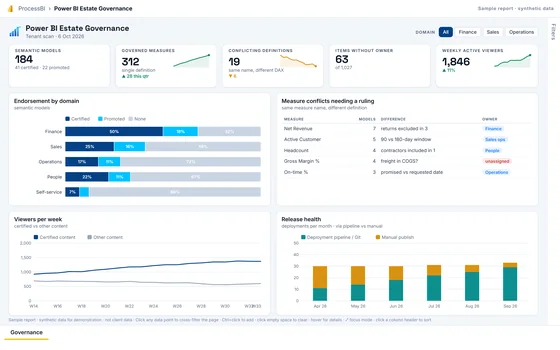
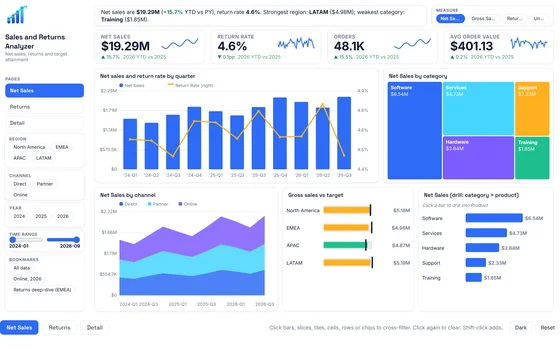
A Power BI engagement can fail while every chart renders correctly. The failure appears later: teams argue about measures, refreshes break without an owner, access grows informally and managers return to spreadsheets before meetings.
ProcessBI evaluates reporting as an operating system for decisions. The report is the visible layer; the important work is the process definition, data lineage, semantic model, control design and adoption behind it.
Begin with the decision, not the dashboard
Ask the consultant to take one management question and trace it backwards. What decision will it support? Which measure represents the issue? At what grain is it calculated? Who owns the definition? Which source events create it? What action follows when it changes?
A strong consultant should be comfortable discovering that the requested visual is not yet buildable because the process or source data cannot support the claim. That is useful professional judgement, not resistance.
Six capabilities to test
Business translation. Can they turn an ambiguous request such as “show productivity” into a defined set of questions, measures, dimensions and exclusions?
Semantic modelling. Can they explain grain, relationships, star schemas, measure ownership and the difference between reusable measures and report-specific logic?
Performance diagnosis. Can they identify whether a slow experience comes from source queries, model design, DAX, visual density, capacity or network behaviour—and show evidence for the conclusion?
Governance and security. Can they design workspace roles, row-level and object-level security, deployment, endorsement, lineage and change control without making self-service impossible?
Product design. Can they reduce cognitive load, select visuals that match the analytical task and make interactions understandable across desktop and smaller screens?
Operational handover. Can they define refresh ownership, monitoring, incident response, documentation, release controls and the path for changing a governed measure?
Ask for evidence, not a tool recital
Instead of asking whether a consultant knows DAX or Fabric, ask them to walk through an example of a disputed measure, a performance bottleneck and a controlled release. The explanation should show what they inspected, what alternatives they considered, how they tested the change and what the client could operate afterwards.
For storage mode, expect a workload-specific choice. Import, DirectQuery and Direct Lake have different freshness, performance, security and operating implications. No single mode is automatically the enterprise answer.
Warning signs in a proposal
- The scope counts report pages but does not define business questions or acceptance criteria.
- The data model is described as a technical implementation detail rather than the shared contract for measures.
- Licensing or capacity is recommended before user, workload and distribution patterns are understood.
- There is no plan for reconciling results with current reports or source records.
- Training covers button clicks but not measure meaning, exceptions or ownership.
- Support begins after go-live, with no monitoring or handover designed during delivery.
A practical selection exercise
Give shortlisted consultants a bounded scenario with a sample measure, two source systems and an access constraint. Ask for a one-page approach—not a free prototype. Compare how they clarify the decision, expose assumptions, structure the model, address controls and define proof of correctness.
The best response is rarely the one with the most features. It is the one that makes uncertainty visible and gives your team a safe route from question to governed answer.
Explore ProcessBI’s Fabric Migration & Power BI Optimisation service, see our interactive reporting demonstrations, or book a scoped technical review.