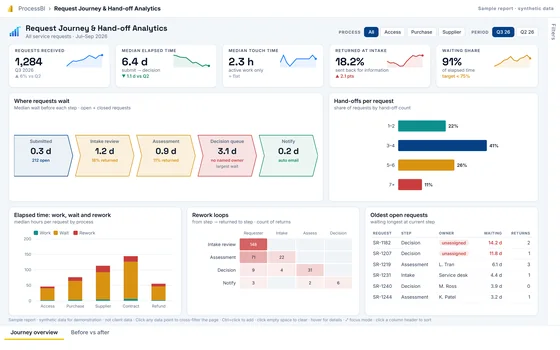
Teams rarely struggle because they cannot draw boxes and arrows. They struggle because different people are describing different versions of the same work.
The procedure says one thing. The system enforces another. Experienced staff know the exceptions, while managers see only the final status. A useful process-mapping exercise brings those views together and makes the gaps discussable.
What business process mapping should reveal
Business process mapping documents how work moves between people, systems and decisions. It should show more than the happy path. The current state needs to make visible:
- where a request enters and what counts as complete;
- who owns each activity and hand-off;
- where work waits, loops back or leaves the system;
- which decisions require judgement and which follow a rule;
- what evidence is created, changed or approved; and
- which variations are deliberate and which are workarounds.
This is why we separate current-state discovery from future-state design. Asking people to describe the ideal process too early hides the very friction the exercise is meant to uncover.
Choose the map for the question
More notation does not make a map more useful. Start with the decision the team needs to make, then use the lightest format that can support it.
| Question | Useful format | What it should clarify |
|---|---|---|
| Where does this process begin and end? | SIPOC | Suppliers, inputs, high-level stages, outputs and customers |
| Who owns the work and the hand-offs? | Swimlane map | Roles, systems, queues and cross-team transfers |
| Where is time or material being lost? | Value stream map | Working time, waiting, movement, inventory and rework |
| How should events and decisions behave? | BPMN | Triggers, gateways, messages, exceptions and end states |
SIPOC: establish the boundary
A SIPOC is useful before detailed discovery. It keeps the team from quietly expanding one process into an entire operating model. If participants cannot agree on the input, output and customer, detailed mapping is premature.
Swimlanes: make ownership visible
Swimlanes are usually the clearest way to discuss operational work. They show where responsibility changes and where a case may be waiting without an active owner. We often annotate system use and evidence on the same map rather than producing separate documents that drift apart.
Value stream maps: separate working time from elapsed time
A value stream view adds measures to the flow. The important discipline is to distinguish touch time from waiting time. A long lead time does not automatically mean staff are slow; the work may spend most of its life in queues, waiting for information or awaiting a decision.
BPMN: use precision when precision matters
BPMN is valuable when event and decision logic must be unambiguous, or when the model will inform workflow automation. It is not necessary for every stakeholder conversation. A technically correct model that operational teams cannot validate is still a weak foundation.
How we run process discovery
Our preferred sequence is simple enough to explain and strict enough to prevent an attractive but unreliable diagram.
- Frame the decision. Define what the map must help the team decide and which process boundaries are in scope.
- Gather evidence. Review procedures, forms, system states, timestamps and samples of completed work where those materials are available.
- Map with practitioners. Speak with people who perform, receive and manage the work. Ask what happens when information is incomplete, a system is unavailable or a case is unusual.
- Validate the current state. Walk a small number of real scenarios through the map. Record unresolved variations rather than forcing premature agreement.
- Add measures. Identify the timestamps, volumes, defects and controls that can test the most important observations.
- Design the future state. Remove avoidable work, clarify ownership and choose automation only after the target flow is understood.
The approach is visible in our quality management and process-control case study, where data capture, assurance, non-conformance handling, reporting and legacy-system synchronisation had to be understood as one operating story.
What makes a process map actionable
A map becomes useful when it is connected to ownership and measurement. For every significant step or hand-off, ask:
- What starts and completes this stage?
- Who owns the work while it is waiting?
- What information is required to proceed?
- Which system holds the authoritative record?
- How would we know this stage is improving?
Do not automate the diagram. First challenge duplicate entry, unclear approvals, low-value checks and exception loops. Automation should implement the redesigned logic, not preserve every step simply because it exists today.
Australian governance and operational resilience
For regulated organisations, process maps can support conversations about ownership, dependencies, controls and disruption scenarios. They do not establish compliance on their own. The relevant risk, legal and compliance specialists still need to decide what evidence is required and whether the controls are adequate.
That distinction matters. A diagram can show that a control exists in the designed process; operational evidence is needed to show whether the control works in practice.
Frequently asked questions
What is business process mapping?
Business process mapping documents how work moves between people, systems and decisions. A useful current-state map records actual hand-offs, waits, exceptions and rework, not only the procedure as written.
Should I use BPMN or a swimlane diagram?
Use a swimlane diagram when the main question is who owns each step and where hand-offs occur. Use BPMN when precise event, decision and message logic is needed, particularly when the model will inform automation. The simplest notation that supports the decision is usually best.
How long does business process mapping take?
It depends on scope, variation, evidence quality and stakeholder availability. Agree the process boundaries and required decision first, then estimate discovery, validation and redesign separately rather than applying a standard duration.
Start with one process and one decision
A useful first engagement does not need to map the whole organisation. Choose a process with a clear owner, recurring friction and enough evidence to test what the team believes. The immediate goal is not documentation coverage. It is a better operational decision.
Explore our process-mapping service, see how it connects to process improvement and redesign, or talk with us about a process that needs attention.