A Fabric migration is not a vote for a product. It is a decision about where data should live, how it should be transformed, who can trust it and how reporting will continue while the platform changes.
That is why ProcessBI starts with the operating questions rather than a target-state diagram. Which decisions are late today? Which pipelines fail quietly? Which measures are disputed? Which workloads genuinely need to move? Until those questions are answered, capacity estimates and migration dates are mostly guesswork.
Start with a workload case, not a platform case
Fabric can bring engineering, warehousing, real-time analytics and Power BI onto a shared SaaS platform. That can simplify an estate, but only when the workloads fit. A useful readiness assessment groups work by source, transformation pattern, freshness requirement, security boundary, downstream consumer and recovery expectation.
For each group, record what is working, what is costly and what would improve if it moved. Some Azure services or source-system workloads may still be the right home. A credible migration plan is allowed to conclude that part of the estate should remain unchanged.
The six questions we use to test readiness
1. Is the inventory complete? List pipelines, notebooks, stored procedures, semantic models, reports, gateways, identities and schedules. Include the informal files and manual reconciliations that keep month-end working.
2. Are business measures defined? Moving contradictory definitions into a new platform does not create a trusted metric. Agree the grain, owner and calculation of important measures before rebuilding the semantic layer.
3. Is the security model understood? Map data classification, workspace roles, row-level and object-level security, service principals, external sharing and network requirements. Regulatory obligations should be translated into testable controls, not treated as a generic compliance label.
4. Has capacity been measured? Use representative refreshes, transformations and user queries. Average utilisation alone can hide throttling during close, reporting deadlines or concurrent pipeline runs.
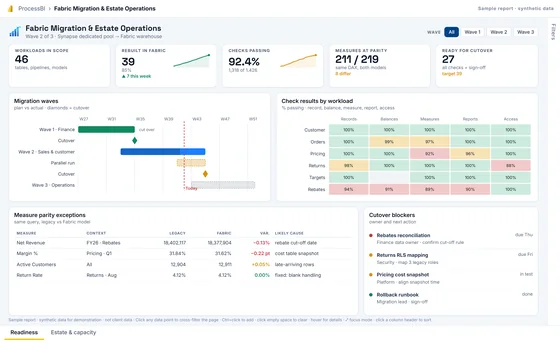
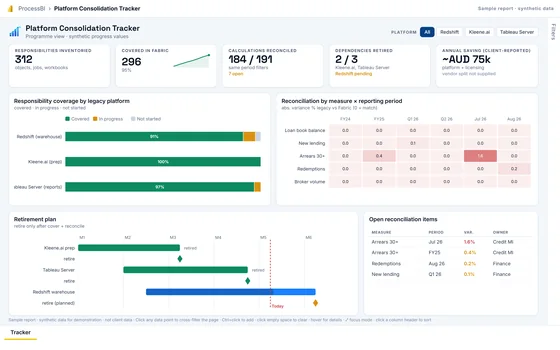
5. Can outputs be reconciled? Define record-count, balance, measure and report checks before development begins. The acceptance criteria belong to business owners as well as the delivery team.
6. Is there a safe cutover? Plan parallel operation, exception ownership, rollback and the evidence required to retire the old path.
Choose the serving pattern from the question
Bronze, Silver and Gold can provide a useful separation between raw, conformed and decision-ready data. They are not a mandatory diagram to copy. The design should reflect replay needs, ownership, data quality controls and how consumers query the information.
Likewise, Import, DirectQuery and Direct Lake are engineering choices rather than maturity levels. Direct Lake can reduce the need for imported copies in suitable Fabric models, but data freshness still depends on ingestion, transformation and model framing. Test performance, security and operating behaviour with the actual workload. Microsoft documents the current Direct Lake behaviour and guardrails.
A migration sequence that keeps evidence attached
- Baseline: inventory the estate and record service levels, failure patterns, costs and critical reporting cycles.
- Design: agree workspace boundaries, ownership, data layers, deployment path, security and capacity assumptions.
- Pilot: choose a representative workload, not the easiest one, and prove ingestion, transformation, semantic modelling and support.
- Migrate by domain: move bounded groups of data products with named owners and reconciliation checks.
- Run in parallel: compare outputs across the business cycles that matter, record exceptions and obtain sign-off.
- Optimise after observation: tune capacity and schedules using telemetry from real use rather than assumptions made during design.
Our view: a platform migration is successful when the business can explain the new measures, operators can support the pipelines and owners can prove the cutover. See how that thinking appears in our Fabric migration and optimisation case study, or review the Fabric Migration & Power BI Optimisation service.
What to ask a Microsoft Fabric consultant
Ask for the workload assumptions behind the architecture, the evidence behind capacity sizing and the exact reconciliation method for cutover. Ask who owns failed runs, disputed measures and access changes after go-live. A useful answer should describe decisions, controls and tests—not only Fabric features.
If those answers are still unclear, an assessment is more valuable than a fixed-price migration promise. Talk with ProcessBI about a scoped architecture and readiness review.